Discover top-rated primary composition notebooks designed for early writers. This guide highlights five kid-friendly options with wide-ruled or primary-ruled pages, drawing space, and durable covers. Each pick supports handwriting practice, drawing, and story creation, helping young learners develop writing skills with clear guidance and attractive designs.
| Product | Brand | Key Feature | Sheets | Size |
|---|---|---|---|---|
| Mead Primary Composition Book, Blue Marble (09902) | Mead | Primary ruled with solid and dotted lines | 100 (double-sided) | 7.5″ x 9.75″ |
| Mead Primary Composition Book, 4 Pack (610053-ECM) | Mead | Manuscript alphabet hints on inside cover | 100 per book | 7.5″ x 9.75″ |
| Oxford Primary Ruled Notebooks (1002521) | Oxford | Dotted midline with blue top line | 100 per pack | 9.75″ x 7.5″ |
| C-Line Primary Ruled Notebook (22020) | C-Line | Illustration space and story-writing layout | Untold pages, primary ruled | 9.5″ x 7.0″ |
| Rosmonde Primary Composition Notebook (B0DG8X7G45) | Rosmonde | Dual-page layout for drawing and writing | 100 per book, 200 pages | 9.75″ x 7.5″ |
Below are five carefully chosen notebooks that balance teachable line guidance with engaging design. Each option supports early literacy, handwriting readiness, and confident storytelling, making them suitable for classroom use or home practice.
Mead Primary Composition Book, Blue Marble
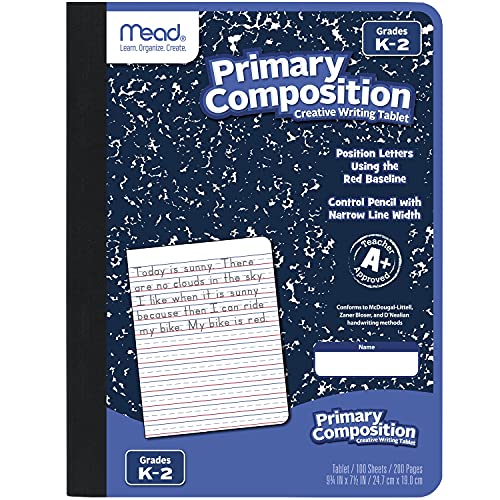
The Mead Primary Composition Book is designed for grades K-2 with 100 double-sided sheets. It uses primary ruling that features solid and dotted lines to guide early writers in letter placement and size. The compact 7-1/2″ x 9-3/4″ format makes it easy to handle for young children, and the sturdy construction supports daily classroom use. This single-subject notebook emphasizes consistent handwriting practice within a familiar, simple layout.
Mead Primary Composition Book, 4 Pack

This 4-pack provides 100-sheet primary notebooks per book with double-sided primary ruling. Inside the cover, a manuscript alphabet and helpful hints offer quick references for new writers. The assorted color set helps classrooms organize by student or group while keeping writing practice visually engaging. Great for establishing consistent handwriting routines across a small group or entire class.
Oxford Primary Ruled Composition Notebooks

The Oxford primary notebooks feature black marble covers and 100 sheets per notebook, with a detailed rule set designed for K-2 learners. The 1/2 inch ruling includes a dotted midline to help with tall, small, and descending letters, while the blue top line and red baseline guide alignment. Durable covers ensure long-lasting use, ideal for early handwriting practice and daily writing activities.
C-Line Primary Ruled Notebook

The C-Line notebook combines story-writing space with primary-ruled lines, including a red baseline and dotted lines to aid letter positioning. The top of the page is unruled for drawing, helping students pair illustrations with writing. An alphabet and numbers are printed in the inside covers, and the back provides guidance on how to write a story. This layout supports integrated literacy development and creative expression in early learners.
Rosmonde Primary Composition Notebook

The Rosmonde 5-pack offers 100 sheets per notebook (200 pages) with a dual-purpose design: a top drawing area and a bottom large primary-ruled section. The paper is thicker to reduce bleed-through from pencils and crayons, supporting a seamless mix of drawing and writing. Its compact 9-3/4″ x 7-1/2″ size makes it portable for school bags, ideal for journaling, note-taking, and creative exercises across multiple subjects.
Buying Guide: Key Purchase Considerations
Choosing the right primary composition notebook involves assessing handwriting guidance, page design, durability, and classroom practicality. Consider these perspectives:
- Primary vs. wide ruling: Primary ruled pages with dotted midlines help beginners maintain letter size and alignment, while wide-ruled pages support larger handwriting and simple sentence construction.
- Drawing and writing balance: Notebooks with dedicated drawing space or an unruled top portion support storytelling and creativity alongside handwriting practice.
- Page and cover quality: Thicker paper reduces bleed-through from pencils and crayons; sturdy covers extend notebook life in backpacks and desks.
- Inside reference materials: Some notebooks include alphabet guides, header space for names, or quick handwriting tips, which can be beneficial for independent practice.
- Quantity and packaging: Bulk packs simplify classroom purchases and reduce the need for frequent restocking, while smaller packs are convenient for individual use or sample trails.
- Size considerations: Common sizes range from around 7.5″ x 9.75″ to 9.75″ x 7.5″; choose a size that fits in students’ folders and backpack pockets.
- Age and grade targeting: Look for grade-specific designs (K-2) that align with early literacy objectives and classroom routines.
- Durability vs. cost: Heavier covers and sewn bindings may last longer but could be pricier; weigh long-term use against upfront cost.
When evaluating options, match notebook features to curriculum goals: handwriting instruction, drawing-led storytelling, and structured practice. The five picks above cover a range of layouts, covers, and formats to accommodate diverse teaching approaches and student preferences.