The following article surveys top 134a refrigerant options that include or pair with UV dye to help detect leaks and monitor system health. Each product is chosen for relevance to standard automotive and small-commercial AC systems, compatibility with common oils, and straightforward application. The selections cover direct UV-dye additives, dye injectors, and complete UV dye kits to give you practical detection tools across various setups.
Overview at a glance: the table below shows five select products commonly used with 134a systems and UV dye for leak detection. This quick reference helps you compare purpose, typical use, and key features at a glance.
| Product | |||
|---|---|---|---|
| TSI Supercool 39241B Total Leak Stop | TSI Supercool | Yes | Evaporators, condensers, hoses, gaskets |
| Aupoko AC Oil and Dye Injector | Aupoko | Yes (UV dye compatibility) | Low-oil injection; works with R134a and R410A |
| Leak Saver Direct Inject UV Dye | Leak Saver | Yes | Finds large leaks with UV dye |
| TSI Supercool D8 UV Dye Green | TSI Supercool | Yes | Detectable under UV light; compatible with oils |
| Tellegloww AC Leak Detector Kit | Tellegloww | UV dye included via injector kit | Includes flashlight, glasses, adapters for multiple refrigerants |
TSI Supercool 39241B Total Leak Stop and U/V Dye

TSI Supercool’s 39241B is designed to stop small leaks in evaporators, condensers, hoses, gaskets, and seals, while incorporating a UV-dye component for leak visualization. The formula is polymer-free to minimize the risk of clogging or harming components, making it suitable for professional service tools and home diagnostics. This 1-can option is marketed as a simple, one-vehicle treatment, ideal for quick field fixes and ongoing maintenance. The product emphasizes compatibility with reclamation or recovery machines and aims to preserve system integrity while enabling leak detection with UV light.
Features to note include a focus on small-leak areas, a polymer-free formulation to reduce clogging risk, and a straightforward one-vehicle dosing option. The dye aids in locating leaks under UV illumination, while the non-polymer formula supports compatibility with common HVAC service equipment. This product is suitable for technicians and DIYers who want an all-in-one solution for both repair and monitoring in R134a-based systems where UV visualization is beneficial.
Aupoko AC Oil And Dye Injector
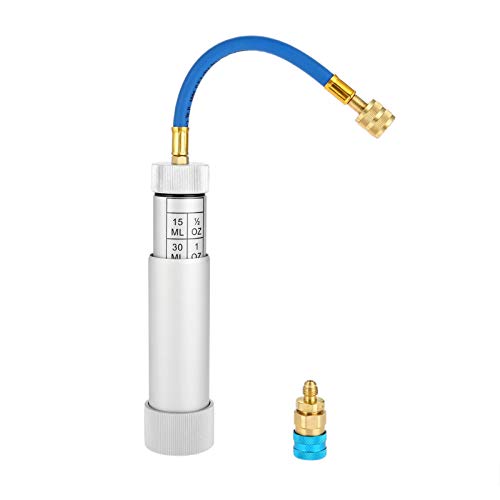
The Aupoko oil and dye injector is a practical tool designed to introduce oil and UV dye into the refrigerant loop. It features a large capacity and a snap quick coupler for fast, reliable connection to the low-side port. The injector is compatible with multiple dyes (including fluorescent UV dyes) and oils, supporting R134a, R410A, R22, and older refrigerants. With a 2 oz capacity and a 1/4″ SAE connector, the unit is designed to operate without relying solely on the compressor to push the dye or oil into the system. It is particularly useful for lean oiling, dye distribution, and preventive maintenance in automotive and home AC systems.
Key strengths include an easy installation process, compatibility with various dye types and oils, and a design that aims to minimize compressor dependence during oil or dye charging. This makes it a versatile choice for technicians working on mixed refrigerant systems or for DIY enthusiasts who want to add UV-dye visibility without a complex setup. The injector helps ensure that dye reaches critical components like the evaporator and condenser for effective leak detection under UV light.
Leak Saver Direct Inject UV Dye

Leak Saver’s Direct Inject UV Dye option is designed for fast, clean injection into the refrigerant system using standard gauge sets or optional injection kits. The product adds UV dye to the refrigerant for visible leak detection and includes UV dye to identify larger leaks under ultraviolet light. This kit emphasizes ease of use, minimal tools, and compatibility with a broad range of refrigerants, including the common R134a and R410A families. It’s positioned as a practical solution for automotive, residential, and commercial HVAC applications where quick leak identification is essential.
Important aspects include an emphasis on straightforward injection without syringes and hoses, compatibility with multiple oils, and UV-dye visibility to highlight leak sites. The kit’s design suits technicians who need a reliable, simple leak-detection workflow and homeowners seeking a practical, do-it-yourself approach to locating refrigerant leaks with UV illumination.
TSI Supercool D8 A/C U/V Dye Green

This self-measure bottle of TSI Supercool D8 UV dye delivers a targeted dye option for R134a and R12 refrigeration systems. The green dye is designed to fluoresce under UV light and is compatible with PAG, ester, and mineral oils. The self-measure bottle format helps technicians accurately dose the dye while maintaining control over dye usage in the system. It is suitable for use in automotive air conditioning and smaller refrigeration setups where UV dye tracing is needed to locate leaks or monitor oil distribution.
Tellegloww AC Leak Detector Kit

The Tellegloww kit combines leak detection with an oil-to-dye dye injector, UV dye, and a comprehensive accessory set. The packing list includes multiple adapters, a mini-split adapter, a UV flashlight, protective glasses, and batteries. This kit is designed to detect leaks across various refrigerants, including R1234yf, R134a, and R410A, while using UV dye to highlight leaks under UV light. The included tools enable quick setup for both car and home AC systems, with a focus on reliability and completeness for field diagnostics and training environments.
Buying Guide: Key Purchase Considerations
- Refrigerant compatibility: Ensure the dye or kit matches your system’s refrigerant (R134a, R410A, or other). Some products claim broad compatibility; verify explicit refrigerant support for your unit.
- Dye type and visibility: UV-reactive dyes are common, but color and brightness under UV light can vary. Green dyes and bright UV dyes provide strong visibility for leaks in dimly lit areas.
- Oil compatibility: If using an injector or dye carrier, confirm compatibility with the oils used in your system (POE, PAG, ester, or mineral). Improper oil-dye pairing can affect system lubrication and dye performance.
- Injection method: Direct inject kits and oil/dye injectors differ in how they introduce dye into the system. Choose based on your comfort level, toolset, and the complexity of your service routine.
- System scope: For large or commercial systems, consider 3-in-1 kits with moisture removal and UV dye; for automotive repairs, compact injectors may suffice.
- Ease of use and accessories: Some kits include UV flashlights, glasses, and adapters. If you work across multiple refrigerants or vehicle types, a kit with broad accessory coverage saves time.
- Safety and compatibility: Review manufacturer guidelines regarding venting, recovery, and disposal. Use dyes and additives only as directed to avoid potential hazards or warranty issues.
- Durability and warranty: For frequent field use, select tools built with durable materials and check warranty terms for replacement or support in case of leaks or clogged components.
Overall, the five products highlighted provide a spectrum of options—from single-use leak stoppers with UV dye to complete injector kits and detector bundles. When selecting, align the product’s dye approach, compatibility with your refrigerant, and the scale of your typical maintenance or repair tasks. This alignment helps ensure efficient leak detection, system safety, and minimal maintenance downtime.